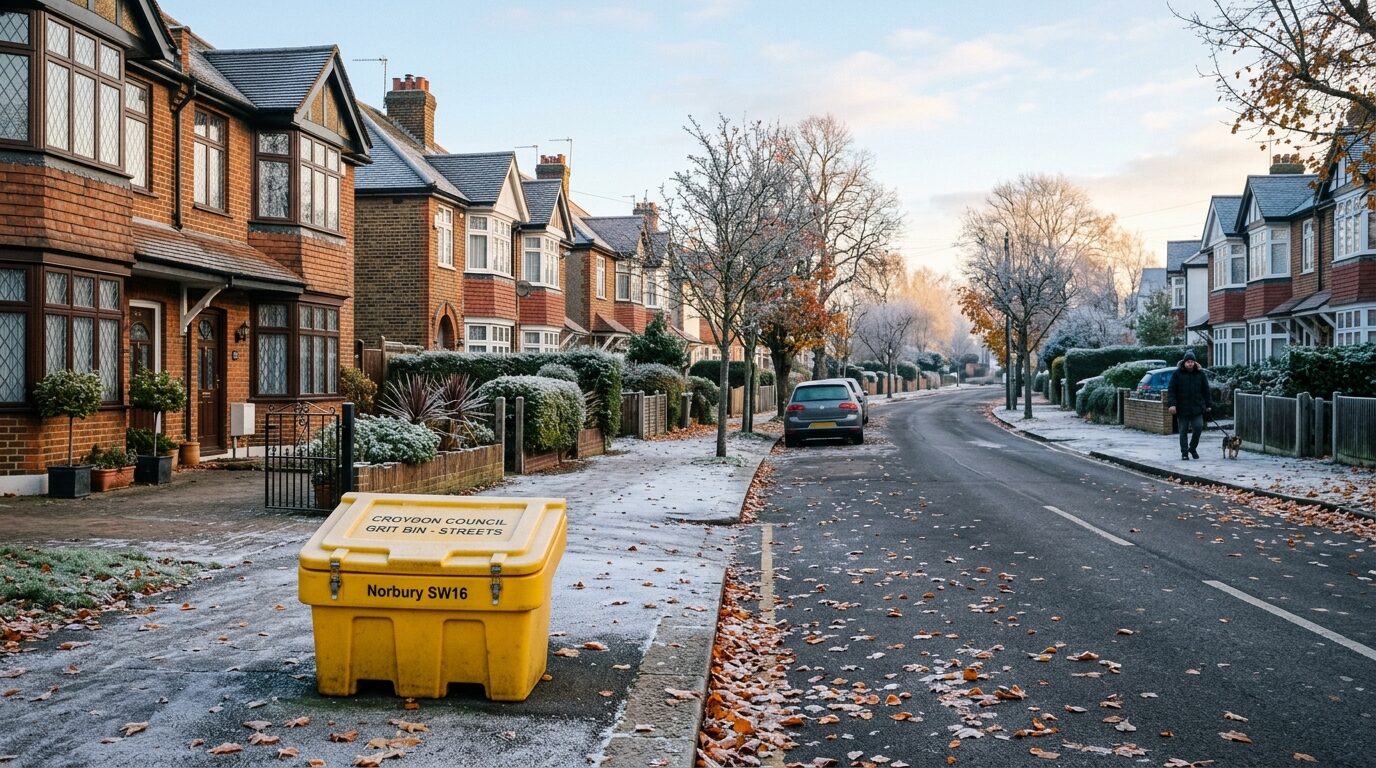
As November temperatures begin to dip across South London, council highways teams are preparing their seasonal winter maintenance operations. For motorists, cyclists, and pedestrians navigating Norbury SW16, understanding how local gritting networks operate—and who is responsible for keeping key bus routes, steep inclines, and residential pavements clear of ice—is essential for safe everyday travel.
Across Norbury, winter road treatment is coordinated primarily by Croydon Council, working in tandem with Transport for London (TfL) on major arterial corridors. By familiarising themselves with official priority routes, salt bin locations, and safe clearing guidance, SW16 residents can plan winter journeys with confidence.
Road Hierarchy: Priority 1 vs Priority 2 Gritting
Croydon Council maintains an extensive winter service plan designed to keep high-volume roads and essential services operational during freezing conditions. Because winter fleets cannot treat every suburban cul-de-sac simultaneously, highways networks are gritted according to strict priority tiers:
- Priority 1 Routes (Precautionary Gritting): These are treated proactively whenever overnight road surface temperatures are forecast to drop below zero with ice or frost expected. In Norbury, Priority 1 coverage centres on major bus corridors, strategic commuter routes, access to Norbury railway station, and approaches to emergency facilities and schools. Key local stretches include Green Lane, Norbury Avenue, Norbury Crescent, and Stanford Road.
- Red Routes (TfL Network): London Road (the A23), which forms Norbury’s central high street and primary north-south spine between Streatham and Thornton Heath, is managed directly by Transport for London. TfL deploys its own dedicated winter maintenance fleet along the A23 red route corridor to keep regional traffic and high-frequency bus services (including the 109 and 255) moving freely.
- Priority 2 Routes (Secondary Gritting): During periods of sustained sub-zero temperatures or heavy snowfall, council gritters expand operations to secondary residential collector roads and steeper residential hills once Priority 1 routes are confirmed clear.
Pollards Hill and Elevated Slopes: How Salt Bins Help
The eastern and south-eastern reaches of Norbury—most notably the steep topography around Pollards Hill, Beech Road, and surrounding avenues—present particular hazards when sudden frost or packed snow coats roads. To support neighbourhood access on steep gradients that lie off primary gritting runs, Croydon Council maintains a network of yellow on-street salt bins:
- Community Use: Salt stored in public grit bins is provided free of charge for residents to spread on public roads, footways, and pedestrian crossings in their immediate neighbourhood.
- Restrictions: Grit bin supplies are strictly intended for public highways; council bylaws prohibit taking rock salt for private driveways, personal paths, or commercial business premises.
- Refills and Damage: Bins are checked and filled ahead of the winter season. Residents who notice an empty, damaged, or vandalised salt bin can report it directly for refilling via Croydon Council’s Love Clean Streets portal at croydon.gov.uk.
Pedestrian Footways and High Street Pavements
During prolonged freezing spells, council street-cleansing contractors treat heavily trafficked pedestrian zones. In Norbury, footway treatment prioritises:
- The busy shopping parade along London Road and Station Approach;
- Pedestrian access paths surrounding Norbury Station and major bus stops;
- Footways immediately outside primary schools, medical surgeries, and Norbury Library on Beatrice Avenue.
The Government Snow Code: Clearing Pavements Safely
Many civic-minded Norbury residents step outside with shovels to clear ice from pavements outside their homes or for elderly neighbours, but some worry about legal liability. Department for Transport guidance—set out in the official national Snow Code—makes clear that householders are not legally liable if someone falls on a path they have cleared carefully:
- Clear Early: Clear fresh snow early in the morning before pedestrian footfall packs it down into compacted ice.
- Never Use Hot Water: Pouring boiling or warm water over icy paths melts the surface temporarily, but it rapidly refreezes into an invisible, lethal layer of black ice.
- Use Salt Sparingly: Ordinary table salt or rock salt works effectively—a single tablespoon per square metre is usually sufficient to dissolve frost and prevent refreezing. Dishwasher salt or garden sand also provides reliable grip.
- Maintain a Clear Path: Shovel snow towards garden borders rather than into gutters or road drains, keeping a clear walkway for prams and wheelchair users.
Checking Winter Travel Alerts
Before setting off on cold mornings, Norbury travellers can monitor live winter road status through several official channels:
- Croydon Council Highways: Real-time updates on winter gritting runs and gritter tracking are published via the council’s winter maintenance webpage and official social media updates.
- TfL Live Travel: Real-time bus diversions and A23 road status can be checked via TfL Go or at tfl.gov.uk.
- Southern Rail: For commuters travelling from Norbury station towards Victoria or London Bridge, check National Rail live departures during freezing conditions for any rail-icing or speed restrictions.
By understanding gritting priorities and looking out for vulnerable neighbours on icy mornings, Norbury residents can ensure the neighbourhood remains safe, mobile, and connected throughout the coming winter months.