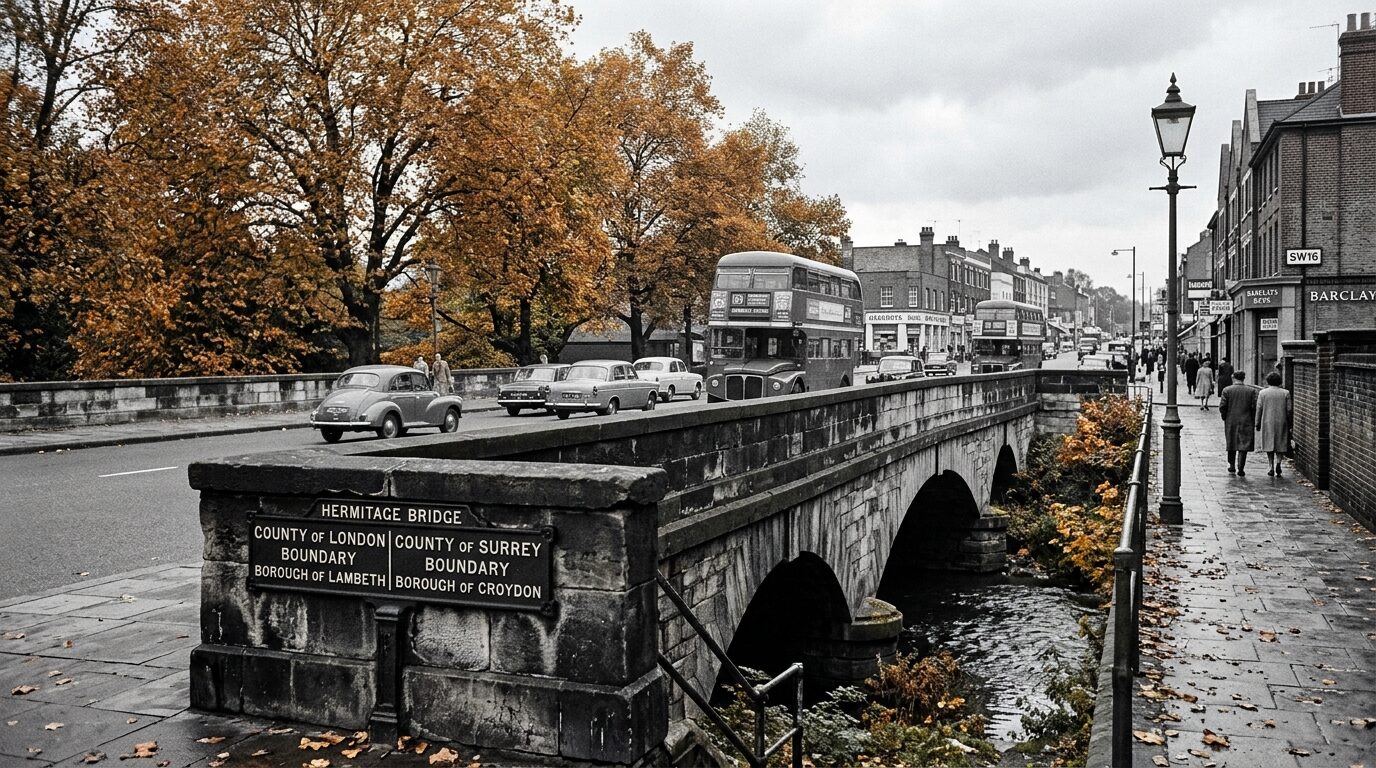
Tucked beneath the busy four-lane asphalt of London Road (the A23), thousands of motorists, bus passengers, and pedestrians pass over Hermitage Bridge every day without realising they are crossing both an ancient river boundary and one of South London’s oldest documented civic crossing points. Linking Norbury SW16 in the London Borough of Croydon with Streatham in the London Borough of Lambeth, Hermitage Bridge marks the exact historical and administrative frontier between Surrey and Greater London.
While modern traffic roars overhead between Streatham Common and Norbury station, the bridge’s weathered brickwork, hidden culverts, and parish boundary plaques preserve a rich heritage stretching back across medieval hermits, royal coaching highways, and Victorian engineering overhauls.
The Medieval Hermit and the Ancient Causeway
The name “Hermitage” originates in medieval times, long before suburban housing spread across southwest London. In the 14th and 15th centuries, the London-to-Brighton route was a treacherous dirt track frequently flooded by the swollen waters of the River Graveney and Norbury Brook. Across damp marshlands, travel required solid timber causeways and stone footings.
According to Surrey parish archives and antiquarian surveys, a pious recluse or hermit took up residence in a modest roadside cell beside the stream. In medieval England, bridge hermits played an essential civic and spiritual role: blessed by local bishops, they maintained river causeways, repaired timber spans, and offered shelter or safe guidance to weary pilgrims and merchants traversing between London and Sussex in exchange for small alms.
From Norbury Brook to River Graveney: The Hydrological Boundary
Hermitage Bridge serves a unique geographic and hydrological function in Norbury’s local landscape. The watercourse that flows westward from Addiscombe springs and through Norbury Park is officially designated as Norbury Brook. However, at the very moment it passes beneath Hermitage Bridge on London Road, its official cartographical name changes to the River Graveney before meandering through Mitcham, Tooting, and Collier’s Wood into the River Wandle.
Throughout the centuries, Hermitage Bridge defined the ancient boundary line separating the historic parishes of Croydon and Streatham. To this day, boundary posts and stone markers set into the roadside masonry confirm the exact line dividing the modern London Boroughs of Croydon and Lambeth.
Coaching Inns, Tolls and Victorian Expansion
During the 18th and early 19th centuries, the rise of Brighton as a fashionable seaside retreat transformed London Road into one of Britain’s busiest mail coach routes. The modest stone and timber bridge was repeatedly widened under the direction of the Croydon and Reigate Turnpike Trust to accommodate four-horse stagecoaches, heavy wagon carts, and drovers leading livestock toward Smithfield Market.
With the arrival of the London, Brighton and South Coast Railway in the 1860s and the rapid Edwardian suburban boom across Norbury, the local stream was heavily engineered. During the early 20th century, Croydon Corporation and Lambeth councils reinforced Hermitage Bridge with heavy blue engineering brick, cast iron girders, and concrete decking to support the newly laid electric tramways running along London Road from 1901.
Spotting Norbury’s Heritage Today
For local residents walking along London Road near Hermitage Lane and Beatrice Avenue, several subtle clues reveal the bridge’s long history:
- The River Arch: Looking over the low parapet on the western pedestrian footway reveals the brick-arched portal where the water leaves Norbury Park and flows freely under the highway toward Hermitage Lane.
- Boundary Markers: Iron boundary plates and historic stone inscriptions set into the curbside landscape denote the administrative division between Croydon and Lambeth.
- Wildlife Corridor: Despite being surrounded by dense urban development, the bridge acts as a vital nature conduit, allowing kingfishers, grey herons, and water voles to navigate between Norbury’s parklands and downstream nature reserves.
Hermitage Bridge stands as a quiet testament to Norbury’s evolving identity—from a secluded medieval river crossing in the Surrey countryside to a bustling South London gateway that millions traverse without ever looking down.