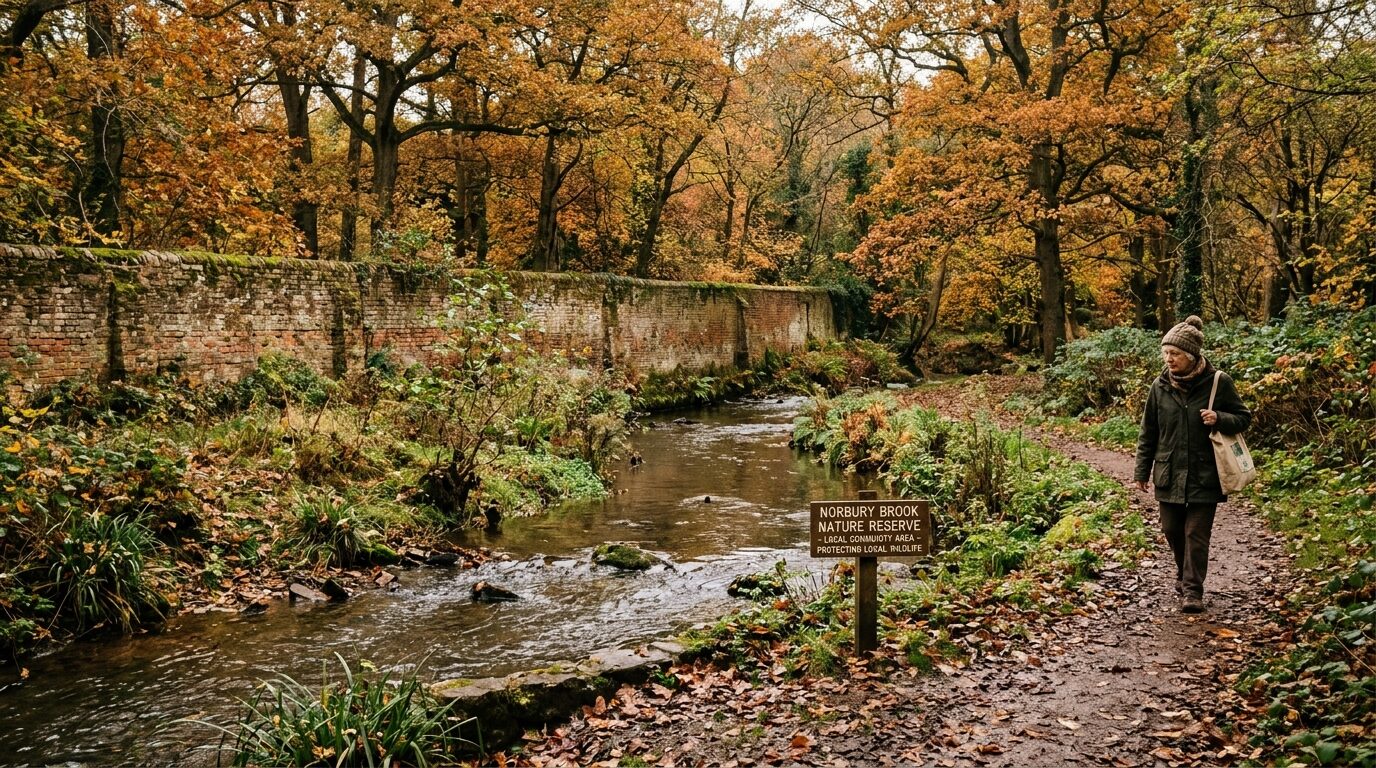
Tucked quietly between residential gardens at the corner of Norbury Avenue and Manor Farm Road, Manor Farm Nature Space preserves one of the most intriguing chapters in SW16’s local heritage. While thousands of commuters pass nearby along the railway line and London Road each day, few realise that this tranquil council-owned nature reserve marks the physical footprint of the ancient Norbury Farm—the historic agrarian heart of Norbury Manor that sustained farming life here for over half a millennium.
Today, the site combines centuries of rural history, wartime civil defence archaeology, and ongoing community-led ecological regeneration, offering a unique pocket of living local history in the heart of suburban South London.
The Medieval Roots: North Burh and the Carew Dynasty
The name Norbury originates from the Old English “North Burh”, designating the fortified northern boundary of the ancient Manor of Croydon. Documented in archival rolls as far back as 1229, Norbury was formally established as a sub-manor of Croydon. By 1269, early surveys recorded an expansive estate comprising 91 acres of arable cultivation around Pollards Hill, alongside rich pastureland, coppiced woodlands, and grazing meadows.
In 1337, the lordship of Norbury Manor was granted to the prominent Carew family, who held Beddington Manor (Carew Manor). The Carews retained lordship over Norbury for more than five centuries until 1859. The historic farmstead—known through centuries as Norbury Manor Farm—served as the operational hub of the agricultural estate.
By the mid-19th century, Norbury Farm spanned approximately 200 acres locally, with the resident tenant farmer cultivating up to 650 acres across the northern reaches of Croydon. The original timber-framed and brick farmhouse stood near the junction of Norbury Avenue and Kensington Avenue until its demolition in 1914, making way for late-Edwardian suburban house building.
Wartime Defence and Twentieth-Century Survival
While surrounding fields were steadily laid out into tree-lined avenues of 1920s and 1930s housing, a residual corner of the former farmyard and water meadows escaped intensive residential development. During the Second World War, the plot was requisitioned for civil defence, witnessing the construction of a subterranean reinforced brick and concrete air raid shelter designed to protect neighbourhood residents during the Blitz. The shelter remains intact on site today, standing as a physical testament to SW16's wartime resilience.
Flowing through the northern perimeter of the reserve is Norbury Brook, the historic tributary that once provided watering grounds for grazing livestock and driven cattle on their route towards London markets.
From Overgrown Ground to Protected Nature Space
For decades in the late 20th century, the triangular remnant lay neglected and prone to illegal fly-tipping. Its revival began in 2014 when civic-minded students from Norbury Manor Business and Enterprise College partnered with the Imagine Health charity to clear overgrown scrub and debris.
Their initial clean-up inspired local residents to establish the Manor Farm Nature Space community association. In May 2017, the council-owned site was officially relaunched as a dedicated nature space during the Chelsea Fringe Festival. Since then, grassroots volunteers and conservation groups—supported by Croydon Council—have nurtured the ground into a thriving wildlife pocket.
Ecological Haven for SW16 Wildlife
Despite its compact urban footprint, Manor Farm Nature Space provides critical ecological connectivity along the Norbury Brook corridor:
- Mature Deciduous Trees: Established sycamores, hawthorns, and native field maples provide vital roosting sites for bats and songbirds.
- Riparian Habitat: The open section of Norbury Brook supports moisture-loving wetland plants, damp soil insects, and foraging corridors for grey wagtails and amphibians.
- Pollinator Habitats: Volunteer working groups have introduced wildflower areas, bug hotels, and deadwood stumperies that nurture wild bees, beetles, and butterflies throughout spring and summer.
Connecting With Norbury’s Living Past
For local residents, Manor Farm Nature Space represents more than just greenery; it is a tangible bridge to Norbury’s pre-industrial past when cows and sheep grazed where suburban roads now run.
Neighbours interested in discovering the site or supporting ongoing seasonal conservation sessions can visit during community open days, connect with local volunteer networks such as Litter Free Norbury and local civic forums, or explore the walking approaches off Norbury Avenue.