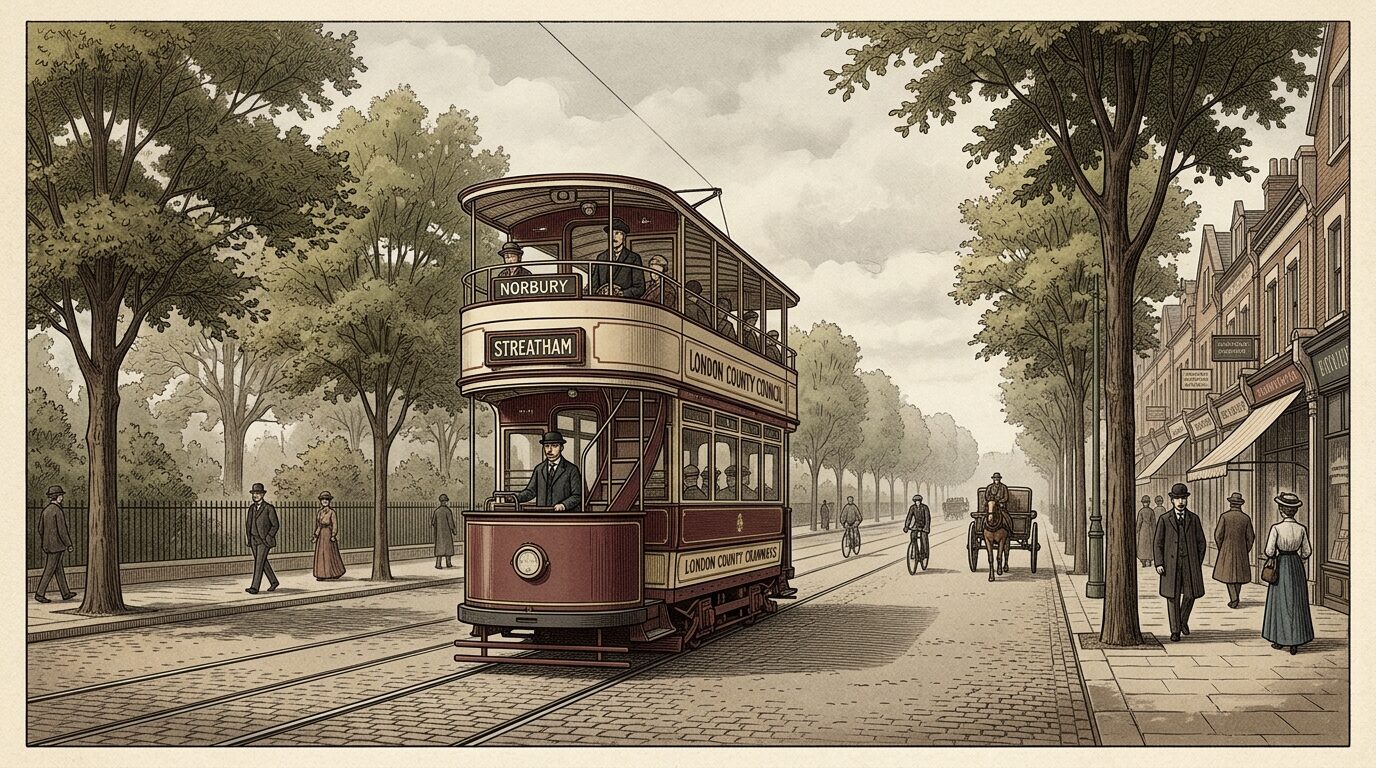
Today’s bus passengers travelling along the A23 London Road through Norbury SW16 follow one of South London’s oldest transport corridors. Before motor buses took over, however, Norbury was a key junction on the capital’s electric tram network—complete with a 17-year border gap at Hermitage Bridge that forced passengers to step off one tram and walk onto another.
Two Tram Systems Meet at Hermitage Bridge
Electric trams first reached Norbury on 26 September 1901, when Croydon Corporation Tramways opened its main route between Purley and a terminus just south of Hermitage Bridge. In 1902, the roadway beneath Norbury’s railway bridge was deepened so double-decker trams could pass safely underneath.
By 1909, the London County Council (LCC) Tramways had extended its Streatham line southwards to Hermitage Bridge. Yet for years, through journeys remained impossible. A six-inch gap separated the two sets of tracks at the boundary, and the systems used different power methods—overhead wires in Croydon versus underground conduit collection on the LCC network.
The 1926 Through-Running Breakthrough
That inconvenience ended on 7 February 1926, when the Croydon and LCC tracks were finally linked at Norbury. For the first time, SW16 commuters could board a single tram and travel continuously between Purley, Norbury, and central London.
Two of the best-known London tram routes serving Norbury were Route 16 and Route 18, which operated circular journeys into central London via Westminster Bridge, Victoria Embankment, and Blackfriars Bridge.
The End of the Tram Era in 1951
In 1933, Croydon Corporation’s tramway operations were absorbed into the newly formed London Passenger Transport Board. Electric trams continued running along London Road through the Second World War, before the capital’s original tram network was gradually replaced by buses. Norbury’s tram services—including Routes 16 and 18—finally closed in April 1951.
While the rails have long since been paved over, the straight, wide sweep of London Road through Norbury remains a lasting reminder of the half-century when electric trams connected SW16 to both Croydon and the Thames.